
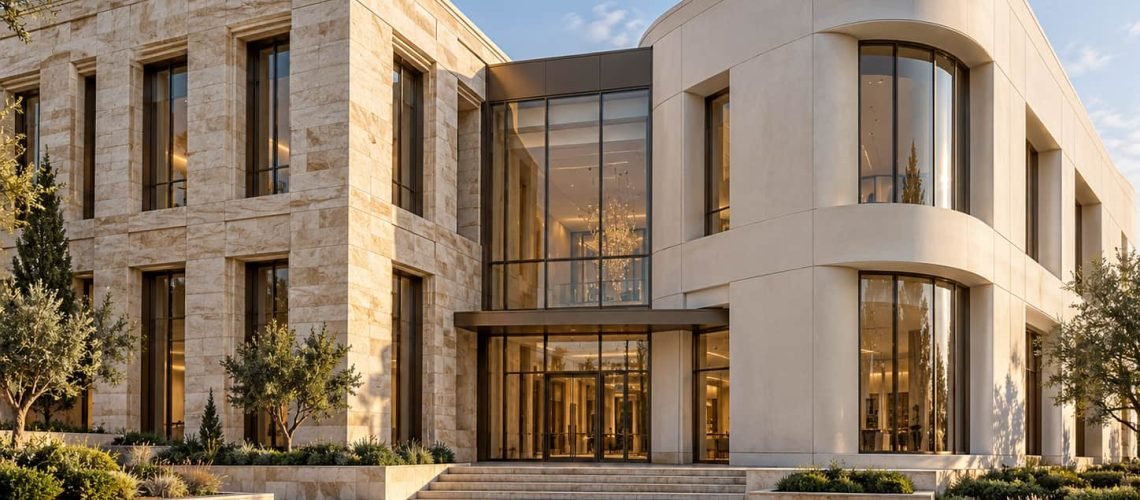
Natural stone has shaped important buildings for centuries. But when a modern facade requires large panels, complex curves, consistent finishes, and efficient installation, GRC may offer a more practical solution.
The right choice depends on what your project values most: authentic natural variation or greater control over weight, form, appearance, and construction.
Is GRC Better Than Natural Stone for Facades?
GRC is often better for lightweight, large-format, curved, or highly customized facades. Natural stone remains valuable when genuine geological character is essential. GRC generally offers greater design flexibility, more consistent finishes, easier handling, and lower structural demands.
That is the short answer.
The complete decision should also consider panel sizes, fixing systems, building height, installation access, finish expectations, production volume, maintenance, and the architectural intent.
Let’s compare the two materials from a facade contractor’s point of view.
What Is GRC?
Glassfiber reinforced concrete, commonly called GRC or GFRC, is a cement-based composite reinforced with alkali-resistant glass fibers.
The cement matrix provides hardness and weather resistance. The distributed fibers improve flexural and tensile performance, allowing manufacturers to produce relatively thin architectural components.
Manufacturers normally form GRC facade panels inside purpose-made molds. This process allows the material to reproduce curves, ribs, relief patterns, cornices, stone textures, and other detailed shapes.
The International Glassfibre Reinforced Concrete Association describes GRC as a material that can be molded into thin, lightweight panels in a wide range of shapes and finishes.
GRC facade panels usually serve as non-load-bearing architectural cladding. Depending on their dimensions and design, panels may connect directly to the building or use secondary steel frames and engineered anchors.

What Is Natural Stone Cladding?
Natural stone cladding uses quarried materials such as granite, limestone, sandstone, travertine, or marble to create the visible facade surface.
After quarrying, fabricators cut large stone blocks into slabs or individual components. They may then hone, polish, sandblast, bush-hammer, carve, or otherwise finish the surface.
Each stone block has its own mineral composition, veining, color distribution, and natural markings. These variations give stone its distinctive character.
Stone facade systems may use mechanical anchors, supporting frames, rails, or adhered installation methods. The appropriate system depends on the stone type, panel size, substrate, building height, loads, and local environment.
The Natural Stone Institute’s resource library includes extensive guidance on stone selection, anchors, joints, tolerances, installation, and maintenance. This reflects the level of technical coordination required for a successful stone facade.
GRC vs. Natural Stone: Key Differences
| Comparison | GRC facade panels | Natural stone cladding |
| Material origin | Manufactured cement composite | Quarried geological material |
| Weight | Relatively lightweight due to thin-wall construction | Generally heavier at conventional cladding thicknesses |
| Shape flexibility | Suitable for curves, reliefs and complex forms | Best suited to flat panels and carved components |
| Appearance | Controlled colors and repeatable textures | Unique natural veining and variation |
| Panel consistency | High when production is well controlled | Natural variation between slabs and batches |
| Installation | Can reduce lifting and structural demands | May require heavier support and lifting equipment |
| Repetition | Molds make repeated shapes efficient | Each component requires cutting or carving |
| Best application | Large, complex or repeatable architectural facades | Projects prioritizing authentic natural material |
1. Weight and Structural Load
Weight is one of the most important differences between GRC and natural stone.
Natural stone is dense. Its weight can require substantial anchors, supporting frames, brackets, and lifting equipment. The Natural Stone Institute notes that stone’s density can create challenges in applications where the supporting structure cannot easily accommodate its mass.
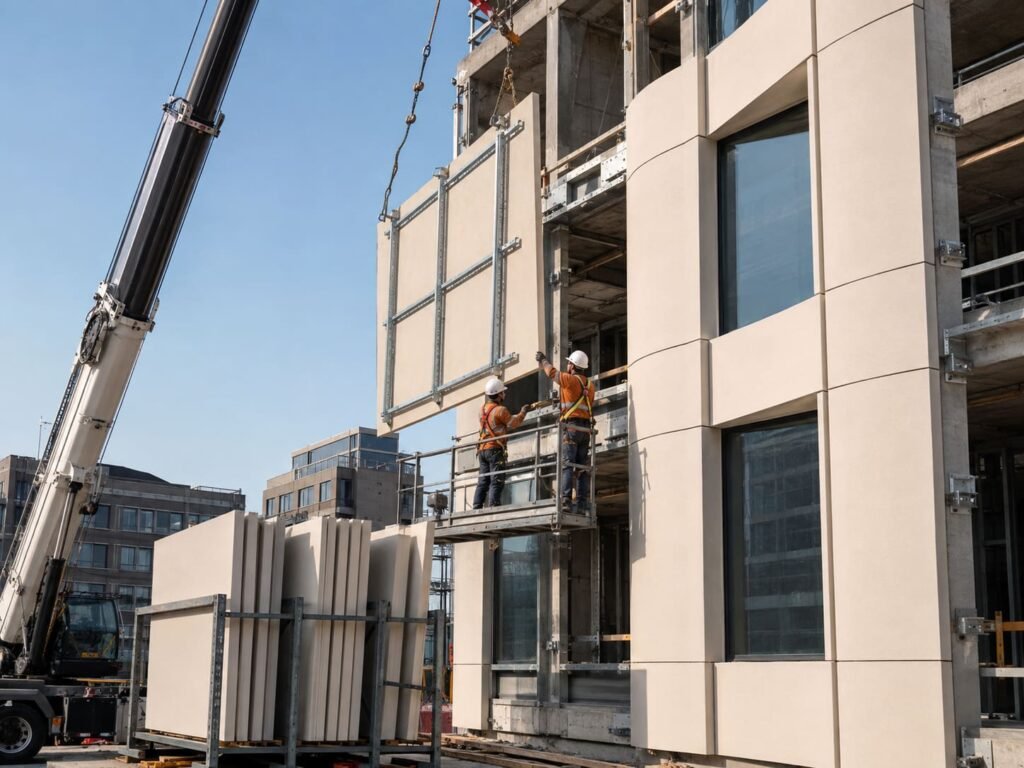
GRC also contains cement and aggregates, but manufacturers can produce it as a thin reinforced skin rather than a thick solid section. This reduces the weight of the finished cladding component.
Lower panel weight may benefit several parts of the project:
- Reduced facade dead load
- Lighter secondary framing
- More manageable transportation
- Smaller lifting equipment
- Easier movement around constrained sites
- Less demand on existing structures in renovation projects
This does not mean every GRC panel is light enough to handle manually. Large framed panels may still require cranes.
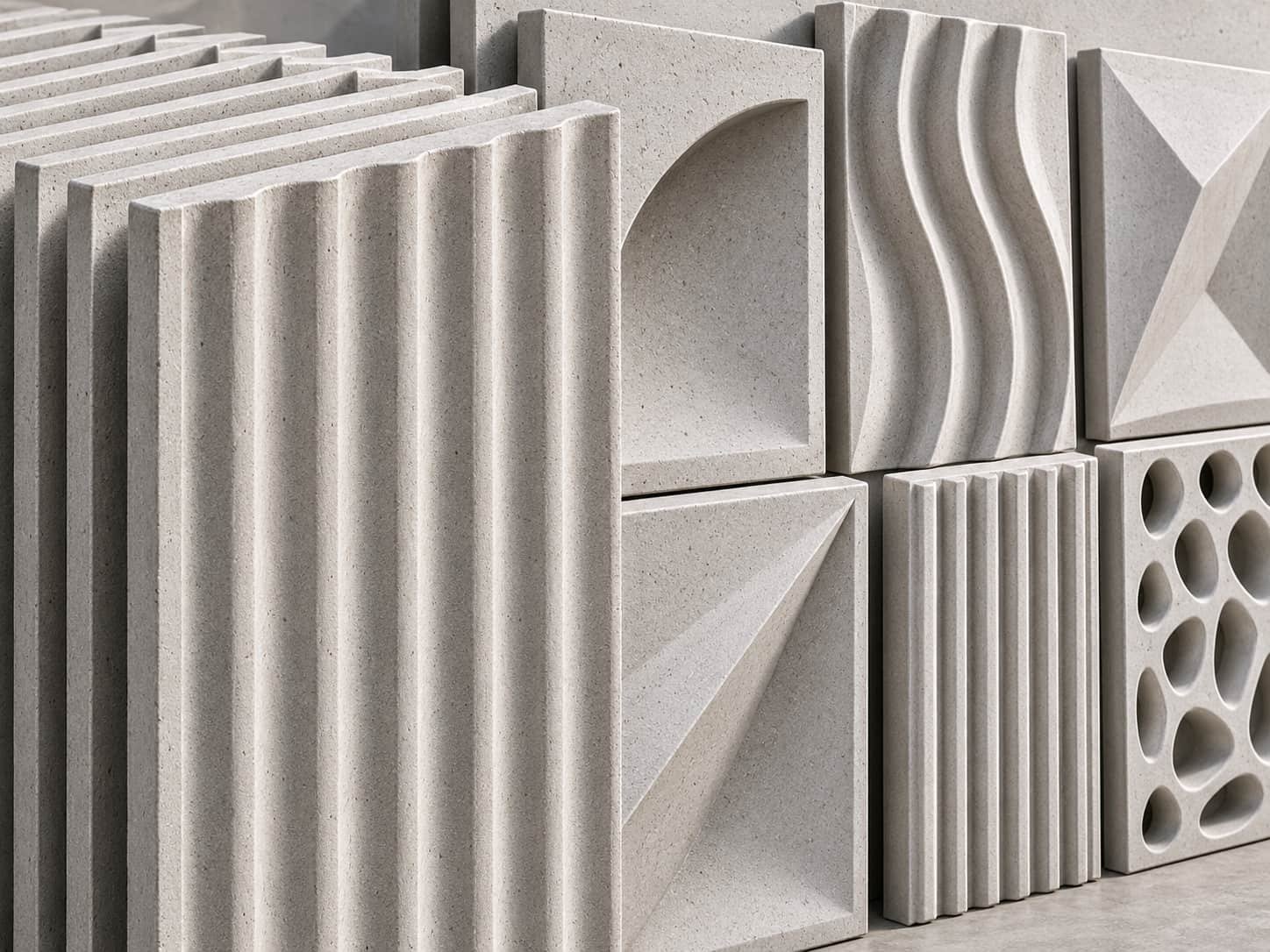
The important point is that GRC can deliver a concrete or stone-like architectural presence without requiring the same material thickness and mass as solid stone.
2. Design Flexibility
Natural stone works beautifully for flat cladding, columns, cornices, and traditionally carved details.
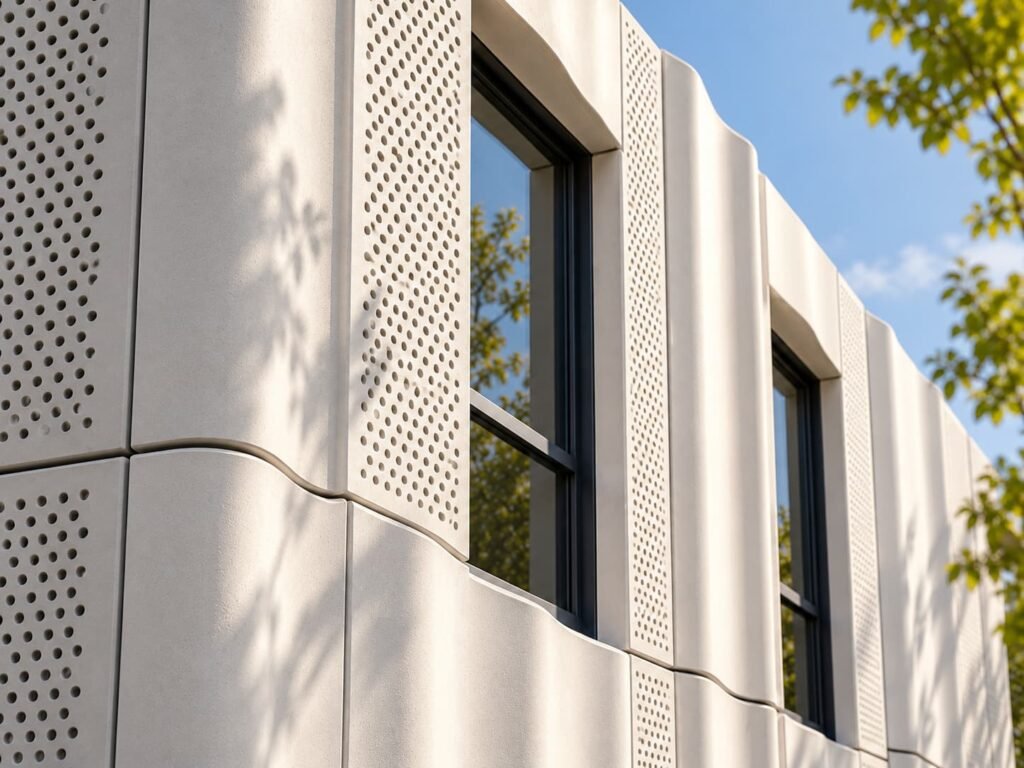
However, complex geometry can become difficult and expensive. Double curves, deep three-dimensional patterns, perforations, and large irregular shapes may require extensive CNC machining, hand finishing, material removal, and individual fabrication.
Stone also has natural grain and veining. Fabricators must consider these characteristics when cutting slender sections or intricate shapes.
GRC takes a different approach.
The manufacturer creates a mold representing the required geometry and sprays or casts the material against it. This allows GRC to reproduce complex forms without carving every piece from a solid block.
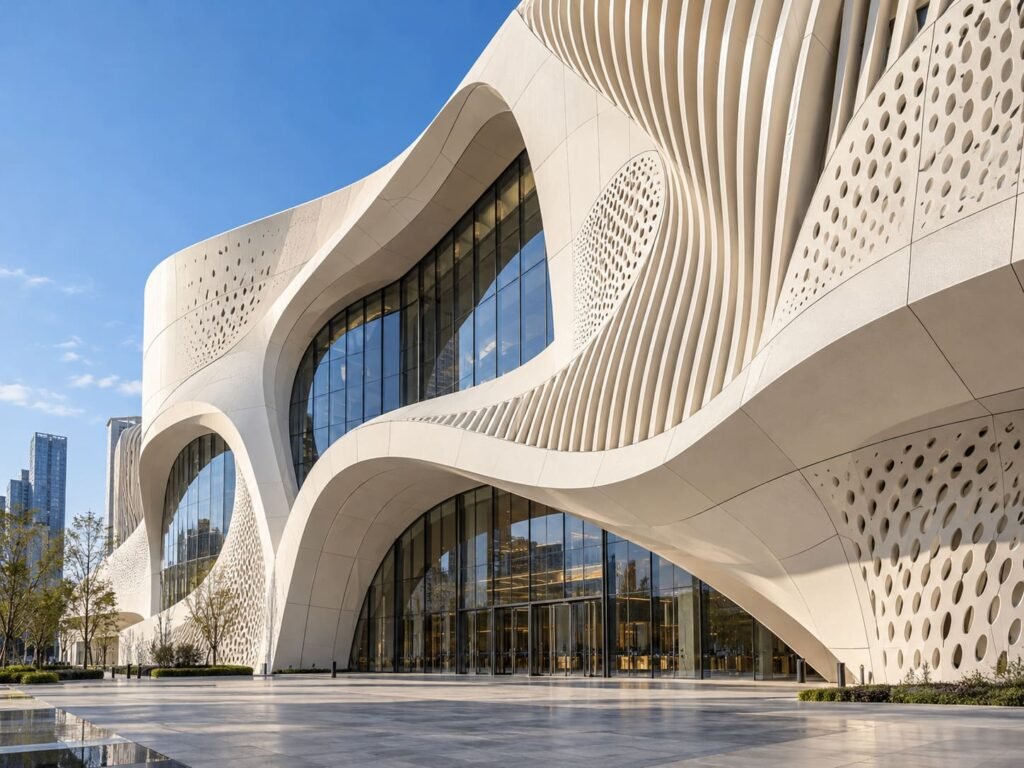
GRC can be suitable for:
- Curved facade panels
- Three-dimensional wall surfaces
- Deep window surrounds
- Fins and vertical features
- Decorative screens
- Cornices and moldings
- Geometric relief patterns
- Stone-like architectural details
For repeated shapes, the same mold may produce multiple panels. This can make a complicated facade more practical once the initial tooling has been completed.
3. Appearance and Material Authenticity
Natural stone wins in one area that GRC should not pretend to replace completely: geological authenticity.
Every piece of natural stone carries patterns formed through natural processes. Marble veining, granite crystals, limestone fossils, and sandstone layers create visual depth that a manufactured surface cannot reproduce exactly.
For entrance walls, feature columns, luxury interiors, or heritage projects where genuine stone is central to the design story, natural stone may remain the right material.
GRC offers a different advantage: controlled architectural expression.
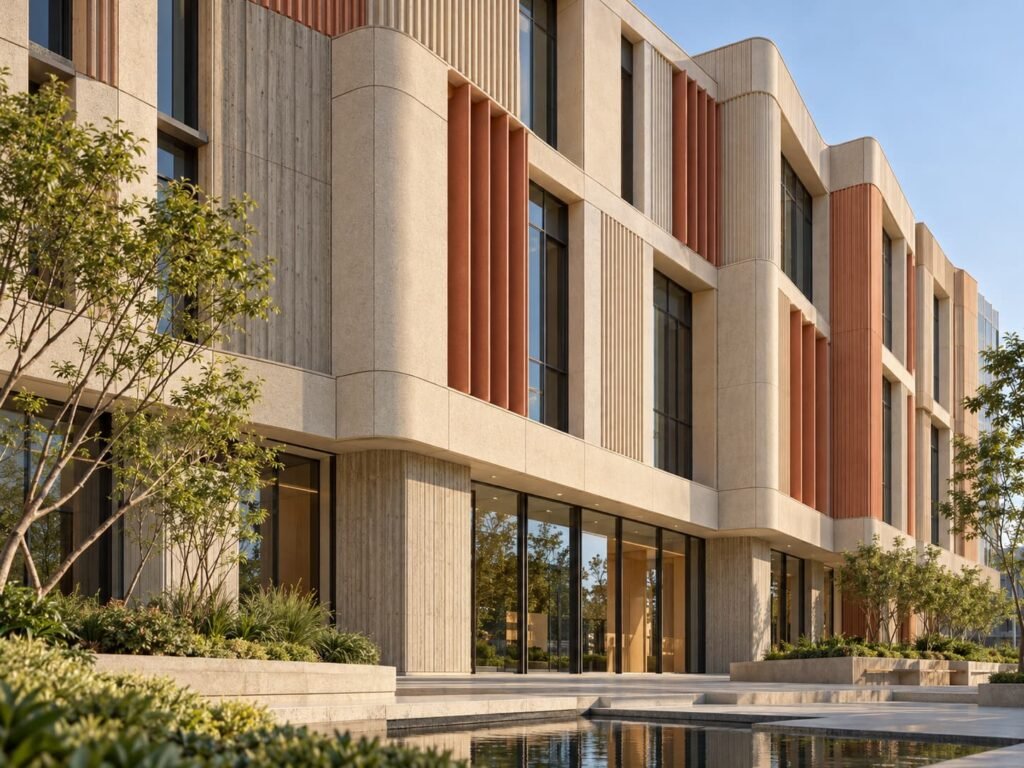
Manufacturers can adjust its color, surface texture, aggregate, mold pattern, and coating system. It can resemble limestone, sandstone, precast concrete, terracotta, board-marked concrete, or other mineral surfaces.
The goal does not always need to be a perfect imitation of stone. In many projects, architects use GRC as an architectural material in its own right.
If authentic, naturally varying surfaces are the priority, choose stone. If the project requires controlled colors and repeatable textures across a large facade, GRC may be easier to manage.
4. Color and Texture Consistency
Natural variation is both the beauty and the challenge of stone.
Slabs from the same quarry may still show differences in color, veining, fossil content, or mineral distribution. Materials purchased at different times may come from another section of the quarry and appear noticeably different.
For a large commercial or residential facade, the stone contractor may need to inspect, photograph, label, sort, and dry-lay components before installation. This helps distribute variation intentionally rather than allowing unexpected color patches to appear on the elevation.
GRC production gives the manufacturer greater control over the ingredients and surface-forming process.
By controlling raw materials, pigments, molds, mixing, spraying, curing, and finishing, a manufacturer can maintain a more consistent appearance across repeated production batches.
GRC can still show natural-looking tonal movement. It is a cement-based material, so minor variation should be expected. However, the manufacturer can define acceptable limits through samples and mock-ups.
For projects that require visual consistency across hundreds of panels, that control may be a significant advantage.

5. Panel Size and Joint Planning
Both GRC and natural stone facades require joints.
Joints accommodate manufacturing tolerances, installation tolerances, thermal movement, moisture movement, and building movement. They also allow contractors to divide a large elevation into components that can be manufactured, transported, and installed.
Natural stone panel dimensions are limited by block size, slab availability, stone properties, fabrication equipment, and handling risk. Larger or thinner pieces may become more vulnerable during cutting and transportation.
The Natural Stone Institute explains that stock availability, fabrication machinery, and building movement create practical limits on stone panel sizes and require carefully designed joints.
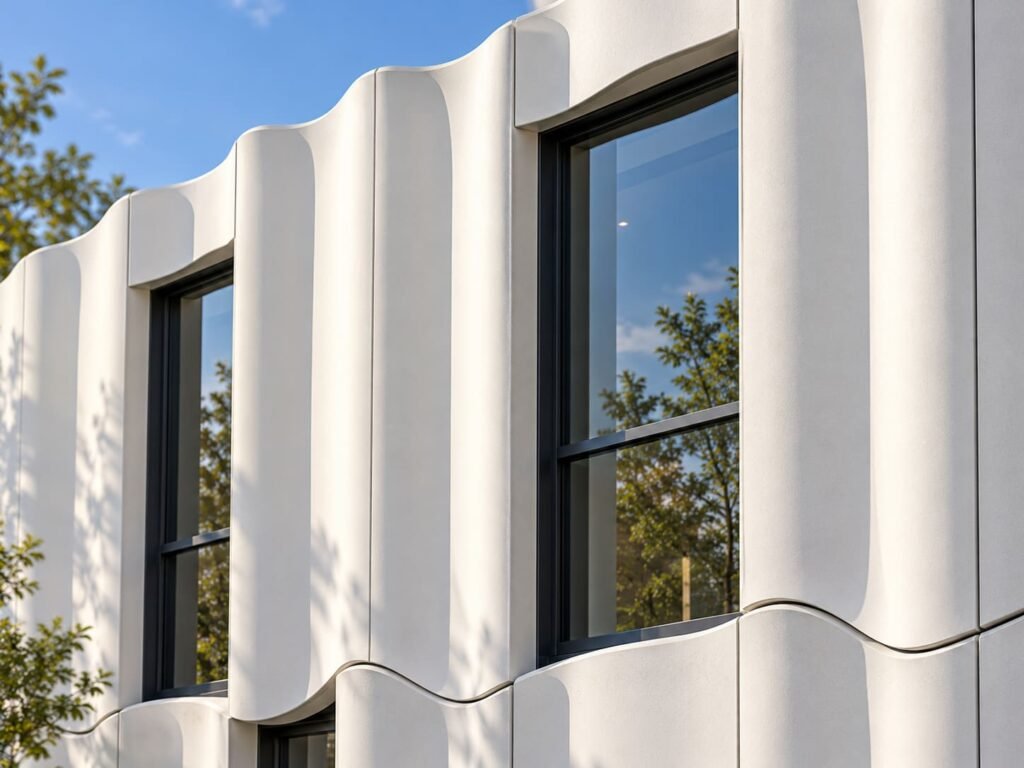
GRC panel dimensions are also limited by engineering, transport, lifting, and installation. However, its lighter thin-wall construction may make larger architectural components more achievable.
Larger panels can reduce the number of visible joints, but they may require stronger steel frames and more careful handling. The ideal panel size balances appearance, mold reuse, container loading, structural behavior, and installation access.
6. Installation and Site Handling
Natural stone installation requires experienced contractors, appropriate anchors, careful lifting, and close control of panel edges.
Damage can be expensive because replacement stone may not match the original batch. A broken carved component may also require significant time to reproduce.
GRC panels can be easier to handle because of their lower weight. This may improve installation speed and reduce lifting requirements, especially where site access is restricted.
Installation efficiency still depends on good preparation.
The supplier and facade contractor should coordinate:
- Panel references and installation sequence
- Lifting points
- Bracket locations
- Support frames
- Adjustment allowances
- Joint widths
- Interface details
- Site access
- Crane capacity
- Temporary bracing
GRC does not automatically guarantee easy installation. A lightweight panel with poorly coordinated fixings can still cause delays.
Its advantage is that manufacturers can design the panel, frame, lifting provisions, and connections as an integrated prefabricated component.
7. Durability and Weather Exposure
Both GRC and natural stone can perform well on exterior facades when designers specify the correct material and detail the system properly.
Natural stone performance varies by stone type. Granite, marble, limestone, sandstone, and travertine do not respond identically to moisture, pollution, salt, freezing temperatures, or thermal movement.
Specifiers must evaluate the actual stone rather than assume every natural material offers the same durability.
GRC performance also depends on its ingredients, manufacturing method, curing, panel design, finish, joints, anchors, and exposure conditions.
Neither material compensates for poor facade detailing.
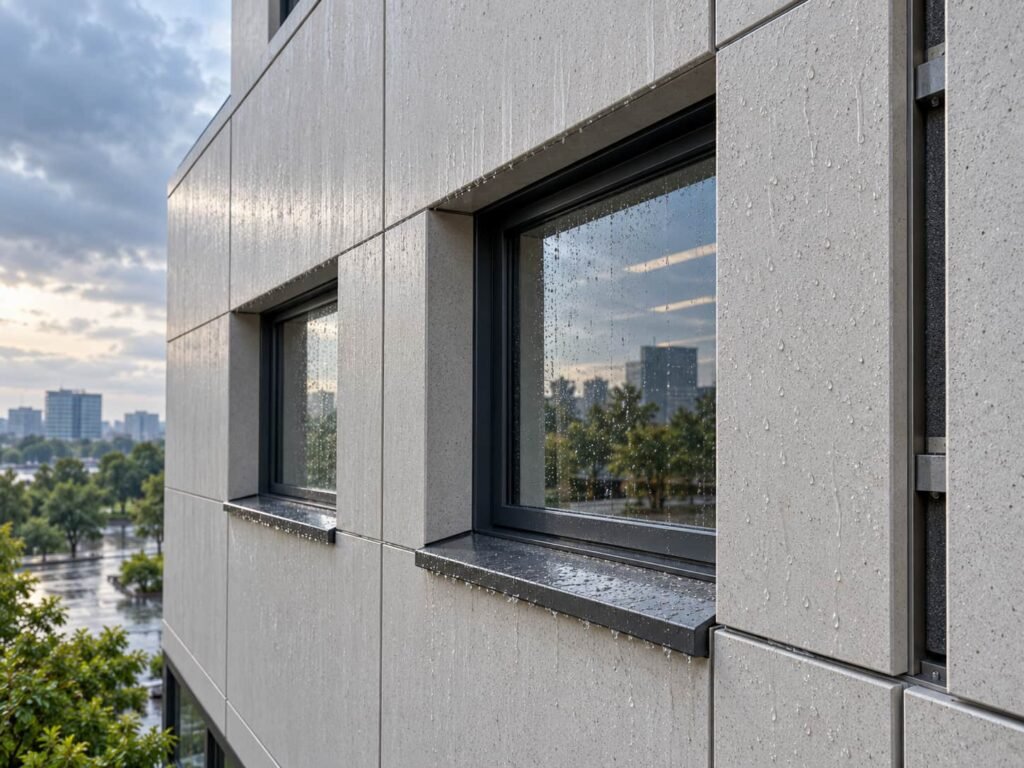
Water drainage, joint design, flashing, sealants, movement allowances, fixings, and interfaces with windows remain critical. A durable panel cannot prevent problems caused by water trapped behind the cladding.
For coastal, freeze-thaw, high-humidity, or desert environments, project teams should discuss exposure conditions with the supplier before approving the material and finish.
8. Project Cost
Comparing material prices alone can be misleading.
Natural stone costs depend on stone type, quarry availability, block quality, slab yield, thickness, finish, cutting, carving, waste, anchors, shipping, and installation.
GRC costs depend on panel geometry, mold quantities, mold reuse, panel size, finish, framing, fixings, production volume, packaging, and delivery schedule.
Simple flat stone and simple flat GRC do not necessarily have the same economic use case.
GRC often becomes more competitive when the project includes:
- Repeated decorative components
- Curved or three-dimensional panels
- Large facade areas
- Restricted structural capacity
- Difficult lifting conditions
- Controlled stone-like finishes
- A need to reduce installation weight
Natural stone may remain competitive when the design uses standard slab sizes, locally available material, simple geometry, and an established stone installation system.
Contractors should compare the complete installed package, including secondary framing, anchors, transport, cranage, installation labor, breakage risk, program, and future maintenance.

When Should You Choose GRC?
GRC may be the better option when:
- The facade contains complex curves or relief patterns.
- Lower cladding weight could benefit the structure.
- The architect wants large-format components.
- Consistent colors and textures are important.
- The design includes repeated custom shapes.
- Installation access or lifting capacity is limited.
- The project requires coordinated factory prefabrication.
- A stone-like appearance is desired without solid stone weight.
GRC is particularly effective for hotels, shopping centers, high-end residences, transportation facilities, cultural buildings, mixed-use developments, and renovation projects.
When Is Natural Stone the Better Choice?
Natural stone may be the better option when:
- Genuine geological character is essential.
- The architect wants naturally unique veining.
- The facade uses simple flat panels.
- Suitable stone is available locally.
- The structure can accommodate the additional weight.
- The project has experienced stone fabricators and installers.
- The design calls for a premium natural material rather than a controlled reproduction.
Stone should not be rejected simply because it is heavier. For the right application, its authenticity and long architectural history can justify the additional fabrication and installation requirements.
Can GRC and Natural Stone Be Used Together?
Yes.
A hybrid material strategy can often produce a better result than forcing one material to perform every role.
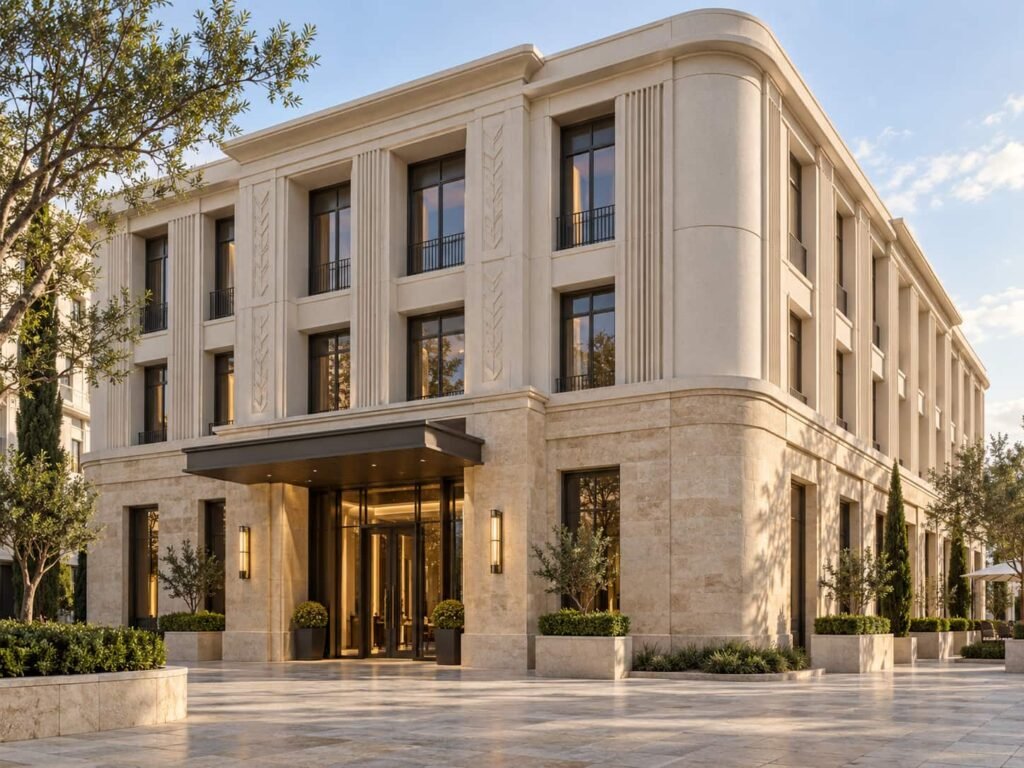
A project might use natural stone at entrances and eye-level feature areas while applying GRC to upper elevations, deep cornices, curved sections, and repeated decorative elements.
This approach preserves authentic stone where people can closely experience it while using GRC where weight, complexity, repetition, and installation efficiency matter more.
The key is finish coordination. Architects should review full-size samples under natural light and define how the two materials should relate in color, texture, joint arrangement, and weathering.
What Information Does a GRC Supplier Need?
For a useful technical review and quotation, provide:
- Architectural elevations and sections
- Preliminary panel divisions
- 3D models for complex geometry
- Required dimensions and quantities
- Color and texture references
- Expected structural loads
- Fixing preferences
- Project location and exposure
- Delivery schedule
- Site-access information
- Packaging and unloading requirements
Early information does not need to be perfect. Preliminary drawings can still help the manufacturer identify difficult shapes, unnecessary mold types, oversized panels, and potential installation issues.
Conclusion
GRC and natural stone can both create durable and visually distinctive facades, but they solve different project problems. Natural stone offers authentic geological variation, while GRC provides lower weight, greater freedom of form, more consistent finishes, and efficient reproduction of custom components. From my experience, GRC delivers its strongest value when manufacturing and installation teams join the discussion early, before panel divisions, molds, and fixing details become fixed.
Conshell manufactures custom GRC facade panels and GFRC cladding for commercial buildings, high-end residences, hotels, and public projects. We support facade subcontractors with design development, panelization, shop drawings, molds, samples, production, quality control, export packaging, and logistics coordination. If you are comparing GRC with natural stone for an upcoming project, send us your drawings, finish references, quantities, and schedule for a project-specific review.